
Sequence risk: Why the order of your investment returns could matter as much as the average
When viewing the performance of your investments, it can be tempting to focus solely on the average returns.
However, this doesn’t always tell the full story, especially when you start withdrawing money from your investments.
Data from the Financial Conduct Authority shows that 401,137 pension plans entered drawdown in 2025/26, up 10.5% from the previous year.
Meanwhile, the total value withdrawn from pension pots rose by 21.7% to £91.2 billion.
As an investor taking an income from your portfolio, the return you achieve isn’t the only factor that matters.
In fact, two people could experience exactly the same investment returns over several years but end up with different amounts if those gains and losses arrive in a different order.
This is often known as “sequence risk”.
Continue reading to discover how sequence risk can affect your investments and why it becomes important when you start making withdrawals.
Sequence risk describes the effect of receiving investment returns in a particular order
Investment returns rarely come in a predictable pattern. You may experience several years of strong growth followed by a period of market downturn. Or, losses could arrive much earlier and be followed by a period of recovery.
If you invest a lump sum and avoid adding or withdrawing any money, receiving the same returns in a different order might not change your eventual outcome.
This is because gains and losses compound on the value you’ve already invested.
Once money starts entering or leaving your portfolio, however, the order can have more of a long-term effect.
For instance, if you’re regularly contributing while markets are falling, your new investments could buy more shares at a lower price.
Conversely, if you’re withdrawing during a downturn, you may need to sell more investments to generate the same amount of income.
This could leave less of your portfolio invested to benefit from any subsequent recovery.
Two investors could experience the same returns but end up with different amounts
An example from Fidelity shows just how much sequence risk can affect your portfolio.
It looks at two investors who each start with £100,000 and experience the same five annual returns in reverse order, as the table below shows:

If neither investor withdraws or adds any money, both would finish the five-year period with just over £113,000.
However, Fidelity then considers what happens if each investor withdraws £5,000 at the start of each year:
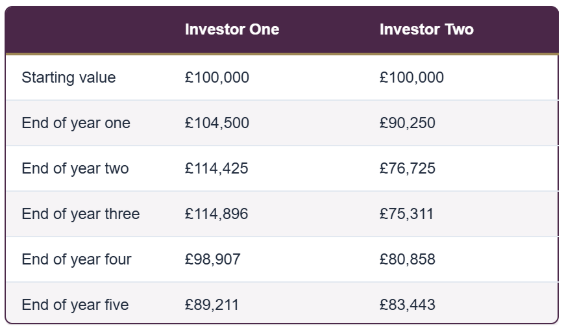
Despite starting with the same amount, withdrawing exactly the same sum, and experiencing the same investment returns, there is a £5,768 difference between their portfolios after five years.
Of course, this is only a simplified example. Still, it shows why an average return alone might not tell you how your investment portfolio will behave in practice.
The effect becomes more important once you start drawing an income
Sequence risk can matter at several stages of your life, but it becomes especially important when you’re regularly taking money from your portfolio.
While you’re still building your wealth, you may be making ongoing contributions and have many years for markets to recover from short-term volatility.
However, if markets suddenly fall shortly after you retire and you continue taking the same level of income from your portfolio, you may need to sell investments after they’ve dropped in value.
Once sold, those investments could no longer benefit from any recovery, potentially placing more pressure on the money that does remain invested.
Just remember that this doesn’t necessarily mean a market downturn early in retirement will automatically derail your plans.
However, it does highlight why assuming your portfolio will simply achieve the same average return every year could give you too neat a picture of how your wealth might change.
There are several ways a financial plan could help you manage sequence risk
While you can’t control when markets rise or fall, having a flexible financial plan could reduce the chances that you need to sell investments at an inconvenient time.
For instance, you might keep enough cash to cover short-term spending, giving your investments time to recover after a market downturn.
Your income may also come from several sources, and deciding which to draw from at various stages of your life could give you more control during weaker periods in the market.
Moreover, diversifying your wealth across asset classes, sectors, and regions could make your portfolio less reliant on the performance of one area.
We could also use cashflow modelling to examine what might happen if markets experience a significant fall shortly after you begin making withdrawals, or compare how different spending levels could affect the sustainability of your wealth.
This could help you build a financial plan that is better prepared for the fact that investment returns rarely arrive in a predictable way.
So, to learn more about how we could support you, please email info@athertonyork.co.uk or call us on 0208 882 2979.
Please note
This article is for general information only and does not constitute advice. The information is aimed at retail clients only.
All information is correct at the time of writing and is subject to change in the future.
Please do not act based on anything you might read in this article. All contents are based on our understanding of HMRC legislation, which is subject to change.
The Financial Conduct Authority does not regulate cashflow planning.
The value of your investments (and any income from them) can go down as well as up and you may not get back the full amount you invested. Past performance is not a reliable indicator of future performance.
Investments should be considered over the longer term and should fit in with your overall attitude to risk and financial circumstances.


Comments